Softwarp is a software technique to warp an image so that it can be projected on a curved screen. This can be done in real time by inserting the softwarp as a last step in the rendering cycle. The problem is to know how the image should be warped to look correct on the curved screen. There are several techniques to auto calibrate the warping by projecting a pattern and using cameras and/or sensors. The information from the sensors is sent to the software so that it can analyze the data and calculate the curvature of the projection screen. == Usage == The softwarp can be used to project virtual views on curved walls and domes. These are usually used in vehicle simulators, for instance boat-, car- and airplane simulators. To make it possible to cover a dome with a 360 degree view you need to use several projectors. A problem with using several projectors on the same screen is that the edges between the projected images get about twice the amount of light. This is solved by using a technique called edge blending. With this technique a “filter” is inserted on the edge that fades the image from 100% light strength (luminance) to 0% (the lowest luminance depends on the contrast ratio of the projector). == History == The first warping technologies used a hardware image processing unit to warp the image. This processing unit was inserted between the graphics card and the projector. The problem with this technique is that it depends on the type of signal and the quality of the signal from the graphics card to warp it correctly. The process unit also needs several lines of image information before it can start sending out the warped image. This adds a latency to the display system that could be a problem in simulators that need fast response time, for instance fighter jet simulators. Softwarping eliminates the latency.
Autonomous agent
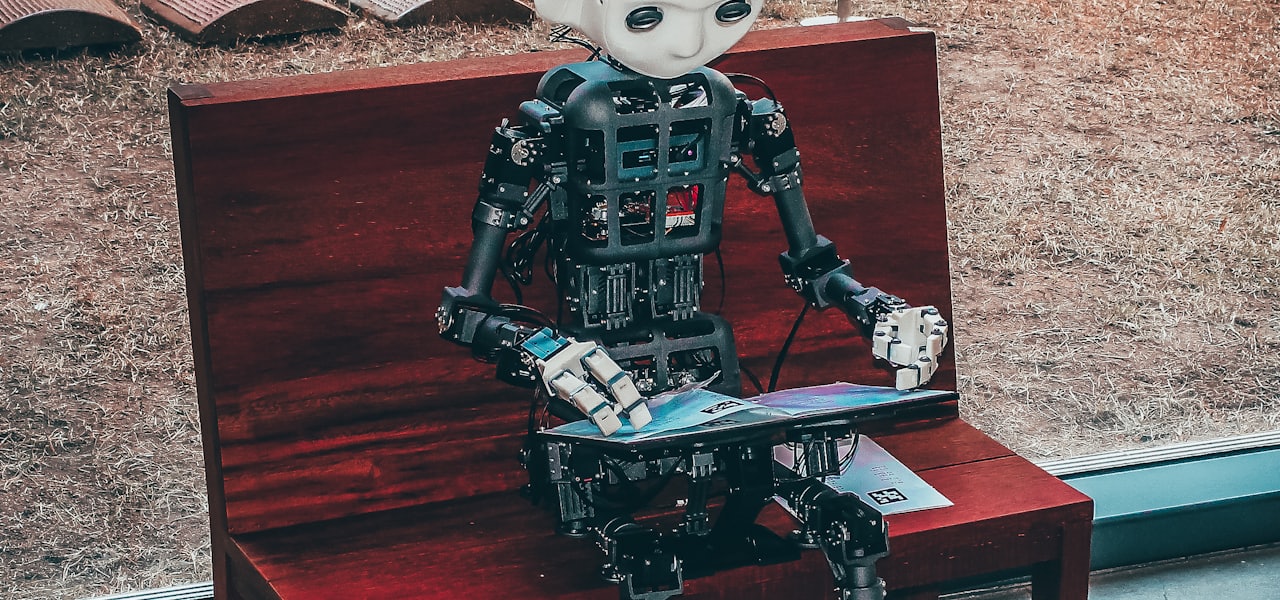
An autonomous agent is an artificial intelligence (AI) system that can perform complex tasks independently. == Definitions == There are various definitions of autonomous agent. According to Brustoloni (1991): "Autonomous agents are systems capable of autonomous, purposeful action in the real world." According to Maes (1995): "Autonomous agents are computational systems that inhabit some complex dynamic environment, sense and act autonomously in this environment, and by doing so realize a set of goals or tasks for which they are designed." Franklin and Graesser (1997) review different definitions and propose their definition: "An autonomous agent is a system situated within and a part of an environment that senses that environment and acts on it, over time, in pursuit of its own agenda and so as to effect what it senses in the future." They explain that: "Humans and some animals are at the high end of being an agent, with multiple, conflicting drives, multiples senses, multiple possible actions, and complex sophisticated control structures. At the low end, with one or two senses, a single action, and an absurdly simple control structure we find a thermostat." == Agent appearance == Lee et al. (2015) post safety issue from how the combination of external appearance and internal autonomous agent have impact on human reaction about autonomous vehicles. Their study explores the human-like appearance agent and high level of autonomy are strongly correlated with social presence, intelligence, safety and trustworthiness. In specific, appearance impacts most on affective trust while autonomy impacts most on both affective and cognitive domain of trust where cognitive trust is characterized by knowledge-based factors and affective trust is largely emotion driven. == Applications == Agentic AI systems: Advanced AI agents that can scope out projects and complete them with necessary tools, representing a significant evolution from simple task-oriented systems. Internet of things (IoT) Integration: Autonomous agents increasingly interact with IoT devices, enabling smart home systems, industrial monitoring, and urban infrastructure management. Collaborative software development: Tools like Cognition AI's Devin aim to create autonomous software engineers capable of complex reasoning, planning, and completing engineering tasks requiring thousands of decisions. Enterprise automation: Business process automation platforms like Salesforce's Agentforce provide autonomous bots for various service functions. == Challenges and considerations == Uncertainty and incomplete information: Autonomous agents must make decisions with limited or uncertain information about their environment and future states. Integration complexity: Incorporating autonomous agents into existing systems and workflows can be technically challenging and resource-intensive. Scalability: As systems become more complex and more agents are used, maintaining coordination and avoiding conflicts becomes increasingly difficult. Trust: Research has shown the combination of external appearance and internal autonomous capabilities significantly impacts human reactions and trust. Lee et al. (2015) found that human-like appearance and high levels of autonomy are strongly correlated with social presence, intelligence, safety, and trustworthiness perceptions. Specifically, appearance impacts affective trust most significantly, while autonomy affects both affective and cognitive trust domains, where affective trust is emotionally driven, and cognitive trust is characterized by knowledge-based factors. Vulnerability to manipulation: Researchers from Harvard, MIT and other educational institutions found that AI agents could become vulnerable to manipulation and could perform detrimental actions in the process of being helpful. == Ethical and regulatory concerns == Accountability: Determining responsibility when autonomous agents make incorrect or harmful decisions remains a complex issue. Privacy and security: autonomous agents often require access to sensitive data, raising concerns about data protection and system security.
Comet (programming)
Comet is a web application model in which a long-held HTTPS request allows a web server to push data to a browser, without the browser explicitly requesting it. Comet is an umbrella term, encompassing multiple techniques for achieving this interaction. All these methods rely on features included by default in browsers, such as JavaScript, rather than on non-default plugins. The Comet approach differs from the original model of the web, in which a browser requests a complete web page at a time. The use of Comet techniques in web development predates the use of the word Comet as a neologism for the collective techniques. Comet is known by several other names, including Ajax Push, Reverse Ajax, Two-way-web, HTTP Streaming, and HTTP server push among others. The term Comet is not an acronym, but was coined by Alex Russell in his 2006 blog post. In recent years, the standardisation and widespread support of WebSocket and Server-sent events has rendered the Comet model obsolete. == History == === Early Java applets === The ability to embed Java applets into browsers (starting with Netscape Navigator 2.0 in March 1996) made two-way sustained communications possible, using a raw TCP socket to communicate between the browser and the server. This socket can remain open as long as the browser is at the document hosting the applet. Event notifications can be sent in any format – text or binary – and decoded by the applet. === The first browser-to-browser communication framework === The very first application using browser-to-browser communications was Tango Interactive, implemented in 1996–98 at the Northeast Parallel Architectures Center (NPAC) at Syracuse University using DARPA funding. TANGO architecture has been patented by Syracuse University. TANGO framework has been extensively used as a distance education tool. The framework has been commercialized by CollabWorx and used in a dozen or so Command&Control and Training applications in the United States Department of Defense. === First Comet applications === The first set of Comet implementations dates back to 2000, with the Pushlets, Lightstreamer, and KnowNow projects. Pushlets, a framework created by Just van den Broecke, was one of the first open source implementations. Pushlets were based on server-side Java servlets, and a client-side JavaScript library. Bang Networks – a Silicon Valley start-up backed by Netscape co-founder Marc Andreessen – had a lavishly financed attempt to create a real-time push standard for the entire web. In April 2001, Chip Morningstar began developing a Java-based (J2SE) web server which used two HTTP sockets to keep open two communications channels between the custom HTTP server he designed and a client designed by Douglas Crockford; a functioning demo system existed as of June 2001. The server and client used a messaging format that the founders of State Software, Inc. assented to coin as JSON following Crockford's suggestion. The entire system, the client libraries, the messaging format known as JSON and the server, became the State Application Framework, parts of which were sold and used by Sun Microsystems, Amazon.com, EDS and Volkswagen. In March 2006, software engineer Alex Russell coined the term Comet in a post on his personal blog. The new term was a play on Ajax (Ajax and Comet both being common household cleaners in the USA). In 2006, some applications exposed those techniques to a wider audience: Meebo’s multi-protocol web-based chat application enabled users to connect to AOL, Yahoo, and Microsoft chat platforms through the browser; Google added web-based chat to Gmail; JotSpot, a startup since acquired by Google, built Comet-based real-time collaborative document editing. New Comet variants were created, such as the Java-based ICEfaces JSF framework (although they prefer the term "Ajax Push"). Others that had previously used Java-applet based transports switched instead to pure-JavaScript implementations. == Implementations == Comet applications attempt to eliminate the limitations of the page-by-page web model and traditional polling by offering two-way sustained interaction, using a persistent or long-lasting HTTP connection between the server and the client. Since browsers and proxies are not designed with server events in mind, several techniques to achieve this have been developed, each with different benefits and drawbacks. The biggest hurdle is the HTTP 1.1 specification, which states "this specification... encourages clients to be conservative when opening multiple connections". Therefore, holding one connection open for real-time events has a negative impact on browser usability: the browser may be blocked from sending a new request while waiting for the results of a previous request, e.g., a series of images. This can be worked around by creating a distinct hostname for real-time information, which is an alias for the same physical server. This strategy is an application of domain sharding. Specific methods of implementing Comet fall into two major categories: streaming and long polling. === Streaming === An application using streaming Comet opens a single persistent connection from the client browser to the server for all Comet events. These events are incrementally handled and interpreted on the client side every time the server sends a new event, with neither side closing the connection. Specific techniques for accomplishing streaming Comet include the following: ==== Hidden iframe ==== A basic technique for dynamic web application is to use a hidden iframe HTML element (an inline frame, which allows a website to embed one HTML document inside another). This invisible iframe is sent as a chunked block, which implicitly declares it as infinitely long (sometimes called "forever frame"). As events occur, the iframe is gradually filled with script tags, containing JavaScript to be executed in the browser. Because browsers render HTML pages incrementally, each script tag is executed as it is received. Some browsers require a specific minimum document size before parsing and execution is started, which can be obtained by initially sending 1–2 kB of padding spaces. One benefit of the iframes method is that it works in every common browser. Two downsides of this technique are the lack of a reliable error handling method, and the impossibility of tracking the state of the request calling process. ==== XMLHttpRequest ==== The XMLHttpRequest (XHR) object, a tool used by Ajax applications for browser–server communication, can also be pressed into service for server–browser Comet messaging by generating a custom data format for an XHR response, and parsing out each event using browser-side JavaScript; relying only on the browser firing the onreadystatechange callback each time it receives new data. === Ajax with long polling === None of the above streaming transports work across all modern browsers without negative side-effects. This forces Comet developers to implement several complex streaming transports, switching between them depending on the browser. Consequently, many Comet applications use long polling, which is easier to implement on the browser side, and works, at minimum, in every browser that supports XHR. As the name suggests, long polling requires the client to poll the server for an event (or set of events). The browser makes an Ajax-style request to the server, which is kept open until the server has new data to send to the browser, which is sent to the browser in a complete response. The browser initiates a new long polling request in order to obtain subsequent events. IETF RFC 6202 "Known Issues and Best Practices for the Use of Long Polling and Streaming in Bidirectional HTTP" compares long polling and HTTP streaming. Specific technologies for accomplishing long-polling include the following: ==== XMLHttpRequest long polling ==== For the most part, XMLHttpRequest long polling works like any standard use of XHR. The browser makes an asynchronous request of the server, which may wait for data to be available before responding. The response can contain encoded data (typically XML or JSON) or Javascript to be executed by the client. At the end of the processing of the response, the browser creates and sends another XHR, to await the next event. Thus the browser always keeps a request outstanding with the server, to be answered as each event occurs. ==== Script tag long polling ==== While any Comet transport can be made to work across subdomains, none of the above transports can be used across different second-level domains (SLDs), due to browser security policies designed to prevent cross-site scripting attacks. That is, if the main web page is served from one SLD, and the Comet server is located at another SLD (which does not have cross-origin resource sharing enabled), Comet events cannot be used to modify the HTML and DOM of the main page, using those transports. This problem can be sidestepped by creating a proxy server in
Creative work
A creative work is a manifestation of creative effort in the world through a creative process involving one or more individuals. The term includes fine artwork (sculpture, paintings, drawing, sketching, performance art), dance, writing (literature), filmmaking, and musical composition. The term is frequently used in the context of copyright. It is an important concept in both philosophy and law. Creative works require a creative mindset and are not typically rendered in an arbitrary fashion, although works may demonstrate (i.e., have in common) a degree of arbitrariness, such that it is improbable that two people would independently create the same work. At its base, creative work involves two main steps – having an idea, and then turning that idea into a substantive form or process. Typically, the creative process results in work that has some aesthetic value, identified as a creative expression. Naturally, this expression generally invokes external stimuli (e.g., influences and experiences) which a person draws on because they view the source as creative or inspirational; the degree to which this is reflected may be used in determinations of the derivativeness of the created work. Alternatively, the creator may draw on imagination, and their references may be clouded even to them, for the nature of imagination is as yet not fully understood philosophically, and the level of necessary self-examination of an artist's internal processing is a challenge for even those most self-aware of their minds and mental processes. == Legal definition == === United Kingdom === For the purpose of section 221(2)(c) of the Income Tax (Trading and Other Income) Act 2005, the expression "creative works" means: (a) literary, dramatic, musical or artistic works, or (b) designs,created by the taxpayer personally or, if the qualifying trade, profession or vocation is carried on in partnership, by one or more of the partners personally.
Flapit
Flapit is a split-flap display that reveals real-time social media statistics such as Twitter followers or Yelp ratings. The product is designed to show off a bricks-and-mortar company's online community and increase its online presence by letting offline customers interact with the connected counter. The idea came from a product launched by the retailer C&A called the Fashion Like. The device can be customised via a web app and API to display any promotional messages, internal stats or discounts. It has 7 digits including numbers, letters and currency symbols Special messages such as Thank You or Like Us can be displayed on the first flap and are translated into Italian, German, French, Chinese, Japanese, Russian, Portuguese, Spanish and English. The Flapit counter was officially presented to the press at the CES Las Vegas 2015 and received favorable reviews from major specialised press
Tute Genomics
Tute Genomics was an American genomics startup that provided a cloud-based web application for rapid and accurate annotation of human genomic data. It was built on the expertise of ANNOVAR. Tute Genomics assisted researchers in identifying disease genes and biomarkers, and assisted clinicians/labs in performing genetic diagnosis. Based in Provo, Utah, Tute was co-founded by Dr. Kai Wang, an assistant professor at the University of Southern California (USC); and Dr. Reid J. Robison, a board-certified psychiatrist with fellowship training in both neurodevelopmental genetics and bioinformatics. Tute Genomics was acquired by PierianDX in 2016. == History == The word "tute" means "personal" in the Na’vi language created for the 2009 film Avatar by Paul Frommer, a linguist and communications professor at the USC Marshall School of Business. === Timeline === 2013 Tute Genomics launched in 2013 and entered the accelerator, BoomStartup. By "demo day" of BoomStartup, Tute had raised their seed round of funding and expanded the round to include angel investors from SLC Angels, Park City Angels, Life Science Angels. Tute was the tenth ever online syndicate for AngelList and in all raised a seed round of $1.5 million. 2014 In March 2014, the company announced that Affiliated Genetics, a Utah-based CLIA-certified laboratory, selected Tute Genomics for its next-generation sequencing (NGS) analytics pipeline. In May 2014, the company announced joining the Global Alliance for Genomics and Health. In June 2014, Advanced Biological Laboratories (ABL), S.A., announced a licensing and collaboration agreement with Tute Genomics and the commercial launch of OncoChek for managing and analysing genomics data in the field of oncology. In July 2014, the company announced an agreement with Lineagen, Inc., to provide next-generation sequencing analytics for Lineagen’s NextStepDx Plus assay. Also, Brigham Young University selected the Tute Genomics genome annotation and discovery platform for analysis and interpretation of 1,000 exomes and genomes. In November 2014, the company announced addition of the Tute platform to Illumina’s BaseSpace. The company announced a Series A1 funding round of $2.3 million in December 2014. The round was led by UK-based Eurovestech. Peak Ventures and a number of angel investors also participated in this round. 2015 Tute recruits David Mittelman, founder of Arpeggi, Inc. and former CSO at FamilyTreeDNA, to Tute Genomics as Chief Scientific Officer. Tute acquires Knome and integrates the KnoSys platform into its software product. 2016 Reid Robison, Tute CEO, launches a Kickstarter campaign to sell Tute interpreted whole genome and whole exome sequencing directly to consumers. The campaign was suspended within the same month after receiving a letter from the United States Food and Drug Administration. Tute is acquired by PierianDX.
Bulletin (service)
Bulletin was an online newsletter platform launched by Facebook on July 6, 2021, that allows notable writers to make announcements directly to their subscribers. Its competitors included Substack, of which Bulletin was called a "near-clone." Writers participating in the platform's launch included Malcolm Gladwell, Mitch Albom, Tan France, Jessica Yellin, Jane Wells, Erin Andrews and Dorie Greenspan. Facebook CEO Mark Zuckerberg stated that Bulletin represented the first time that the company had "built a project that is directly for journalists and individual writers." In October 2022 Meta announced the shutdown of Bulletin. The platform went into read only mode in January 2023 and became unavailable in April 2023. == History == Facebook announced Bulletin as its online newsletter platform on June 29, 2021. and launched by the company on July 6, 2021. Facebook CEO Mark Zuckerberg touted the service by saying that Bulletin represented the first time that the company had "built a project that is directly for journalists and individual writers." Writers participating in the platform's launch included Malcolm Gladwell, Mitch Albom, Tan France, Jessica Yellin, Jane Wells, Erin Andrews and Dorie Greenspan. == Reception == Unlike competitor such as Substack, Facebook indicated upon service's launch that it would not take a cut of subscription fees of writers using that platform. According to Washington Post technology writer Will Oremus, the move was criticized by those who viewed it as a form of predatory pricing intended by Facebook to force those competitors out of business. Sandeep Vaheesan, legal director of the think tank Open Markets, called for the government to reexamine predatory pricing as a violation of antitrust law, saying, "We want companies to compete by making better products, investing in new equipment and tech — not purely relying on their financial advantages to capture market share."